Was this helpful?
Thumbs UP Thumbs Down

An affordable BYD Dolphin Surf is available overseas, but American drivers still can’t buy one from a dealer

BYD Dolphin Surf or Seagull on the road
Rear shot of BYD Dolphin Surf or Seagull on the road.

BYD undercuts today’s affordable U.S. EVs on price

The car sold in Europe as the BYD Dolphin Surf is known in China as the Seagull. The current 2026 Seagull starts at about 69,900 yuan, or roughly $10,400 at recent exchange rates, while higher trims cost more. Its longest listed China-market range is 405 kilometers, or about 252 miles, under the CLTC test cycle.

That remains a sharp contrast with U.S. EV pricing. Tesla currently lists the Model 3 Rear-Wheel Drive at $36,990 before destination and order fees, with an estimated purchase price of $38,630 including those fees. The comparison illustrates how much cheaper some small EVs are in China.

Cropped view of car production line.

BYD built the affordable EV U.S. brands still lack

BYD has developed the Dolphin Surf as a small electric car aimed at buyers who want low prices without giving up technology or sporty design. The model sits in the same broad space once targeted by affordable EVs such as the Nissan Leaf and Chevrolet Bolt.

Its combination of compact size, strong range, and available performance makes it especially notable. The bigger issue for American shoppers is that this type of low-cost BYD EV remains unavailable in the U.S. market.

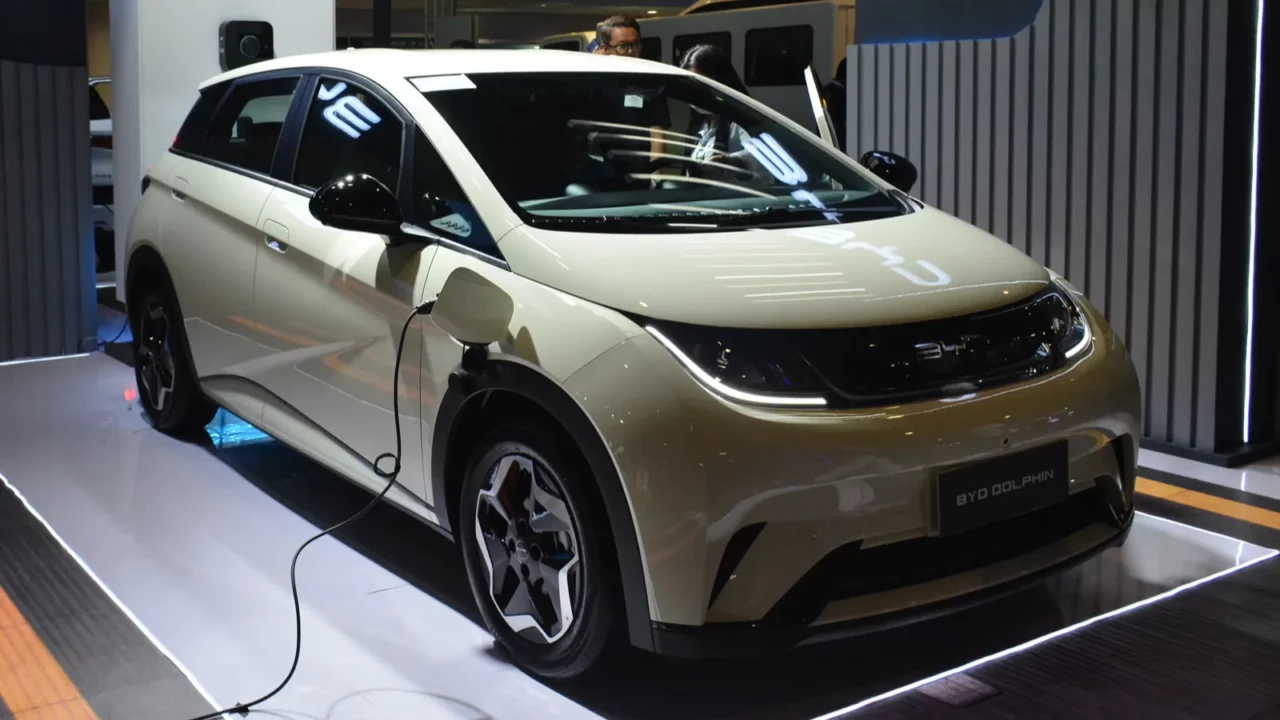
Shot of BYD Dolphin on the display.

The Dolphin Surf gives budget EVs a sportier look

BYD gives the Dolphin Surf a distinctly sporty design for a compact city EV. The car uses a single-arch profile, prominent body contouring, sharp lighting details, and an integrated rear spoiler to create a more dynamic appearance.

For the 2026 model year, BYD lists Lime Green, Skiing White, Obsidian Black, and Ice Blue among the available exterior colors. The styling emphasizes visual character without changing the Dolphin Surf’s primary role as a compact urban electric car.

Professional engineer works on a computer.

BYD packs modern technology into its small EV

The Dolphin Surf includes a strong technology package for a compact electric car. Earlier versions feature BYD’s 10.1-inch electrically rotating touchscreen, along with Apple CarPlay, Android Auto, and “Hi BYD” voice control.

For the 2026 model year, the range-topping Comfort version receives a larger 12.8-inch infotainment display with Google Built-in, while BYD has also revised cabin materials. Active and Boost versions now use fabric upholstery, while Comfort retains vegan leather.

BYD fast charging

The small BYD EV makes efficient use of its cabin space

The Dolphin Surf is compact on the outside, measuring about 3.99 meters long, but its dedicated EV architecture and 2,500-millimeter wheelbase help maximize usable interior space. BYD also offers a 308-liter cargo area that expands when the rear seats are folded down.

For the 2026 model year, BYD has added five-seat versions in some European markets while retaining four-seat configurations where appropriate. These packaging choices make the Dolphin Surf more practical than its small exterior dimensions might suggest.

Chevrolet Bolt EV shown at display

The most powerful Dolphin Surf produces about 154 hp

The range-topping Dolphin Surf Comfort uses a 115 kW electric motor rated at 156 PS (154 hp) and 220 Nm of torque. BYD lists a 0-to-100-km/h time of 9.1 seconds.

That is substantially less output than the current 2027 Chevrolet Bolt’s 210 hp and the 2026 Nissan Leaf’s available 214 hp. The Dolphin Surf is therefore better described as a compact city EV with adequate performance than as a 200-hp performance-oriented hatchback.

Shot of an EV battery pack.

BYD uses Blade battery technology in the Dolphin Surf

The Dolphin Surf uses BYD Blade batteries with lithium iron phosphate, or LFP, chemistry. LFP is widely used for its advantages, including relatively low cost, long cycle life, and strong thermal stability.

European Dolphin Surf versions use 30 kWh or 43.2 kWh batteries. For the 2026 model year, BYD lists WLTP combined ranges of 220 km for Active, 322 km for Boost, and 310 km for Comfort. The related 2026 China-market Seagull is rated at up to 405 km under the CLTC cycle, not 510 km.

Byd charging station electric

Fast charging helps make the small BYD more practical

The Dolphin Surf is designed to reduce some of the charging inconvenience associated with electric cars. Its battery can reportedly charge from 30% to 80% in less than 30 minutes under suitable conditions. That gives drivers a faster way to add useful range while stopped.

Charging speed still depends on the vehicle version, charger, and conditions, but the capability makes the small hatchback more practical for daily use. For budget EV buyers, charging convenience can matter almost as much as purchase price.

Tesla cars on display

A roughly $10,000 Chinese EV shows how wide the U.S. price gap can be

The China-market version of the Dolphin Surf is called the BYD Seagull. The 2026 Seagull starts at 69,900 yuan, equivalent to roughly $10,400 at recent exchange rates, with higher trims costing more.

That is far below the current affordable U.S. EVs. The 2027 Chevrolet Bolt starts at $28,995, while Tesla’s current Model 3 has an estimated purchase price of $38,630 after destination and order fees. The difference helps explain why inexpensive Chinese EVs receive so much attention outside the U.S.

Cars waiting for export.

U.S. trade and security rules keep BYD passenger EVs out of reach

BYD does not sell the Dolphin Surf through U.S. dealers, and the barriers now extend beyond tariffs. U.S. Section 301 rules impose a 100% additional tariff on covered Chinese electric vehicles.

The Commerce Department has also adopted connected-vehicle restrictions. Beginning with model year 2027, the rules prohibit certain sales of connected vehicles by manufacturers with a sufficient nexus to China or Russia, as well as vehicles containing covered software.

Those restrictions create a much more direct obstacle to a company such as BYD entering the U.S. passenger-car market.

BYD Dolphin Surf or Seagull on the road

Chinese EV competition could pressure U.S. car prices

The Dolphin Surf highlights the pressure Chinese automakers could place on global EV prices if their lowest-cost models gain wider access. The model is sold for under €20,000 in some European markets, offering a very different starting point from many American electric cars.

Wider competition could force automakers to focus more closely on battery costs, manufacturing efficiency, and affordable vehicle design. For U.S. car buyers, the debate is not only about Chinese brands. It also concerns how quickly domestic companies can build cheaper EVs.

Shot of BYD showroom.

BYD’s EV strategy emphasizes value, scale and useful technology

BYD has built substantial cost advantages through scale, vertical integration, and in-house battery production.

The Dolphin Surf reflects the company’s value-focused approach with compact dimensions, Blade battery technology, connected infotainment, and a range of practical equipment. The most powerful current Dolphin Surf is rated at 115 kW (about 154 hp), rather than 201 hp.

BYD’s ability to combine competitive pricing with technological innovation and rapid product development has intensified competition in global EV markets. At the same time, U.S. automakers and policymakers continue to debate how much access Chinese vehicle companies should have to the American market.

Detroit automakers’ challenge to Trump’s openness to Chinese carmakers highlights the industry’s push to preserve barriers against Chinese vehicle and technology expansion in the U.S. market.

BYD Dolphin Surf or Seagull on the road

The Dolphin Surf raises a bigger question for U.S. EVs

The BYD Dolphin Surf and its China-market Seagull counterpart illustrate how aggressively small EVs can be priced outside the United States. The current Seagull starts at about 69,900 yuan, or roughly $10,400, while the European Dolphin Surf tops out at 115 kW, or about 154 hp, and offers up to 322 km of WLTP combined range.

U.S. rules currently make a BYD passenger-car launch particularly difficult. In addition to high tariffs on covered Chinese EVs, Commerce Department restrictions prohibit certain sales of connected vehicles by China-linked manufacturers beginning with the 2027 model year.

The broader challenge for U.S. automakers is to continue reducing EV prices while delivering competitive range, technology, and charging performance.

CATL plans to launch battery production in Hungary, underscoring how major Chinese battery companies are expanding overseas manufacturing while facing tighter scrutiny in the U.S.

Would you choose an $18,000 EV over a similarly priced gas-powered car if it were available in your area?

Don’t forget to follow us for more exclusive content right here on MSN

Read More From This Brand:

This slideshow was made with AI assistance and human editing.

Was this helpful?
Thumbs UP Thumbs Down
Prev Next
Share this post

Send feedback to evsmarts


    We appreciate you taking the time to share your feedback about this page with us.

    Whether it's praise for something good, or ideas to improve something that isn't quite right, we're excited to hear from you.